Search This Blog

Thursday, April 29, 2010

Google datasharing and what do about it

Institute of Disruptive Studies... love it... (sorry, I was having a monty python moment...)

-----

The project, called GoogleSharing, is a Firefox add-on that uses an anonymous proxy service that gives Google false information when someone uses services that don't require an account, such as its search, news, and images services, said Moxie Marlinspike , a security consultant and penetration tester with the Institute of Disruptive Studies.

Google collects a vast amount of information about its users, said Marlinspike, who gave a presentation at last week's Black Hat conference. The company collects IP (Internet protocol) addresses, search requests, browser type and more.

More here at yahoo news

About googlesharing: http://www.googlesharing.net/

---------

Also, for web editors who use google analytics, you might want to read Google's data sharing informational blurbage...

Monday, April 26, 2010

More scary facebook privacy news

You know, facebook, you keep this up, users will eventually leave... Really. myspace probably never thought it would happen to them, either.

-----------------

Facebook's new system for connecting together the web seems to have a serious privacy hole, a web developer has discovered.

Some people report that they are able to see the public "events" that Facebook users have said they will attend – even if they person is not a "friend" on the social network.

More here...

http://www.guardian.co.uk/technology/2010/apr/26/facebook-privacy-hole

My writings about facebook and privacy here (including how to protect yourself and still be part of facebook):

http://contentdivergent.blogspot.com/search/label/facebook

and on privacy

http://contentdivergent.blogspot.com/search/label/privacy


whitehouse.gov moves to drupal

Obama's campaign site was running Expression Engine... interesting to see this move to opensource. (yay! opensource.... altho' I do have a special spot in my heart for EE, it's where I cut my CMS teeth... where I began to be brave enough to contribute solutions to a public forum ... LOL)

Last week, WhiteHouse.gov announced its release of custom code developed during its first six months of Drupal implementation for WhiteHouse.gov. The news was also revealed during a speech at DrupalCon (video) in San Francisco on April 21.

The open source code, created by the president's web team, will allow developers to re-use what the White House has developed. There are four contributions from WhiteHouse.gov:

  • A module called "Context HTTP Headers," which allows website builders to add new metadata to the content they serve. "We use this to tell our servers how to handle specific pages, such as 'cache this type of page for 15 minutes' or 'that type for 30,'" explained the Whitehouse.gov press release.
  • A module called "Akamai," which allows WhiteHouse.gov to integrate with its content delivery network.
  • A module called "GovDelivery," which allows emails to be customized to users' specifications.
  • A module called "Node Embed," which makes sure all images on the site have the appropriate metadata to make them readable via screen-reading software.

Friday, April 23, 2010

Tightening down your facebook privacy

As part of making the web more "social", Facebook recently announced a whole slew of changes in April 2010. In addition to that, some new things popped up under privacy... so you might want to take a look. For one, it now looks like you can control who sees your gaming activity to a greater extent (my non-gaming fb friends, I know you are tired of me begging for help to raise a bigger barn....). I am excited about that one and I'm not sure how recent this one actually is. (details follow)

>SHARING YOUR INFORMATION OUT ON THE WEB
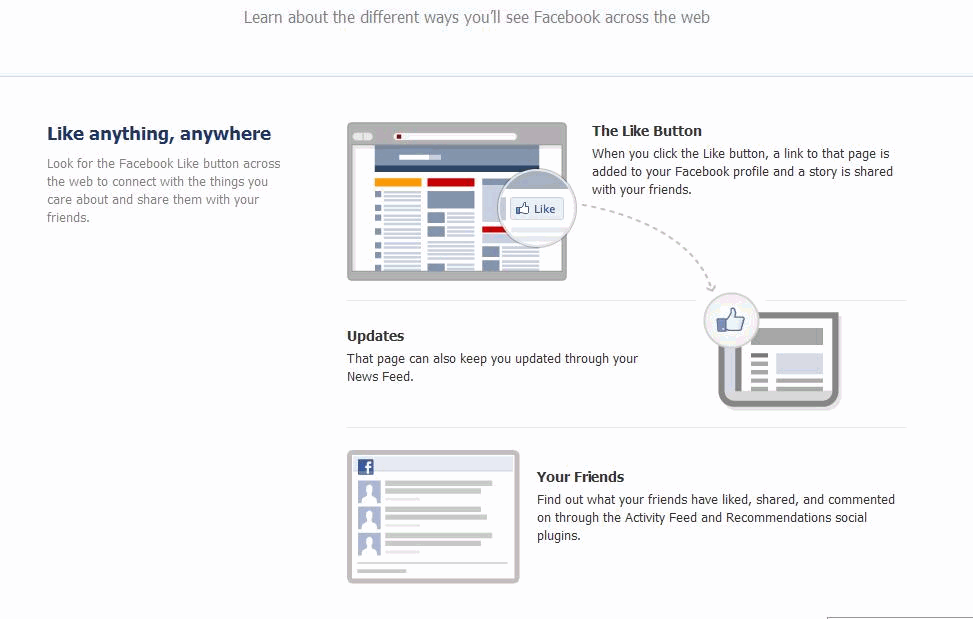
When you login to facebook, you'll now see an information blurb about the new "like" button. Clicking on it, will give you alot more information, which is worth the read.

from Facebook:
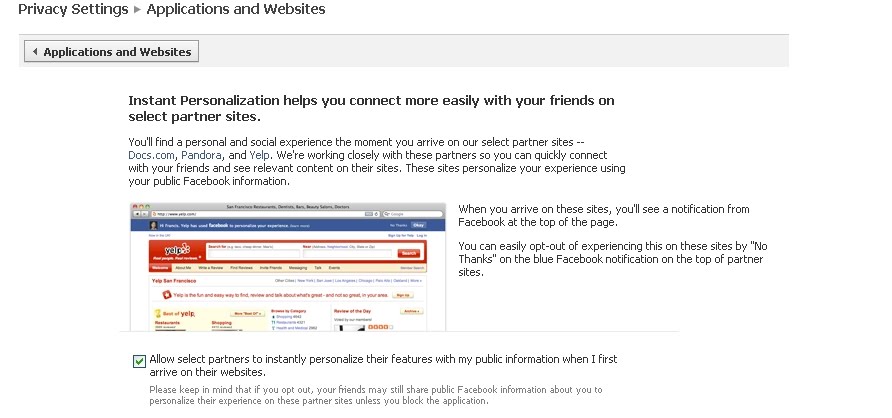
When you visit a Facebook-enhanced application or website, it may access any information you have made visible to Everyone (Edit Profile Privacy) as well as your publicly available information. This includes your Name, Profile Picture, Gender, Current City, Networks, Friend List, and Pages. The application will request your permission to access any additional information it needs.


Um, yeah. So when you go to an outside website (e.g., CNN) if they are using a facebook plugin, you've just made information available to them. I would think the information sharing would not be a passive transfer (but that would seem to depend on the app), but instead would be based upon an action you do, such as "like" a story. Scary, no?

HOW TO TURN IT OFF (hopefully)
  • Account Settings>Privacy Settings>Applications and Websites
  • Instant Personalization>Edit
  • Uncheck Allow.

I've also now read that you need to go to each application and block it and turn off the functionality on that side.

PAGES (changes)

(which you now "like" instead of fan, so...)
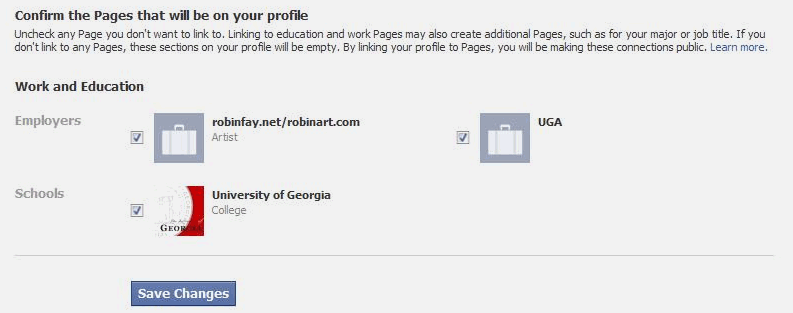
When you go to your profile after these changes, a screen should pop up asking you if you want to link your pages to your profile. Your answer most likely depends on how tightly you want to control your profile.


Note, these are pulling from employer info and I am okay with those (for now), but I do wonder then how much they are sharing back with UGA. Egads, talk about alumni spam opportunities...

CONTROLLING YOUR GAMING ACTIVITY DISPLAY
Ok, I figured this out -- it is related to the Games dashboard NOT the wall post.
Sigh.
So far, I have been able to individually set posting for game posts to my wall, so creating a gaming list is useful. If the post has the lock, you can then just choose your game list.
  • Under Account>Privacy Settings
  • Applications and Websites
  • Click on privacy (audience group)
  • Click on customize
  • Build your list of fellow gamers or those who share other applications
If you would rather not have your recent application activity visible in the dashboards to your friends, you can change this through your Privacy settings . We're also working on a more granular set of controls for specific applications, so that you can turn off activity for certain applications while leaving it on for others.


Wednesday, April 21, 2010

GALILEO birthday coming up

I totally meant to post this earlier. On Sept. 21, 2010 it will be the 15th anniversary of GALILEO.
Hopefully, it okay to crosspost this...
----------------
Happy New Year, GALILEO Users,

Believe it or not, GALILEO will turn 15 on September 21, 2010. Way back in 1995, long before Google, GALILEO helped bring the University System of Georgia libraries, students, faculty, and staff the ability to search indexes and retrieve full-text materials on this new thing called the “World Wide Web” using something called “ASCII text.” For many of these users, GALILEO was their first introduction to the Internet, much less graphical interfaces, as well as the benefits this technology had for learning and research. In fact, GALILEO helped put public computers into the University System libraries and provided fax machines for interlibrary loan articles, at time when some campuses had a single fax machine in the President’s office. Institutions that had only a few journals suddenly had access to hundreds of journals. GALILEO’s delivery over PeachNet helped people understand the benefits of robust networks for transmitting data, providing the impetus and legislative support for bringing both internet access and GALILEO to public libraries and schools. Even in this era of ubiquitous information that has followed its early innovation, GALILEO still provides the core resource for the libraries and media centers of Georgia, fulfilling its mission to be “One Statewide Library” by bringing quality, authoritative, and secure digital materials of all kinds to the citizens of Georgia, including encyclopedias, books, thousands of periodicals, and unique materials of historical and cultural significance. Over one billion user experiences attest to the success of GALILEO.

The spirit of innovation and collaboration that has been part of GALILEO since the beginning continues, as today GALILEO has multiple interfaces that serve different audiences and communities of interest, special tools for federated searching and linking to ejournals across all resources, a toolbar for easy use in common browsers, online training for library staff, and video tutorials for users. The future promises to continue apace, as new discovery tools and tools to assist the integration of library resources into online learning environments enhance the GALILEO environment.

As a teenager, GALILEO will continue to need the support, encouragement, and thoughtful guidance of the GALILEO community; the birthday is a great opportunity to share and express the value that GALILEO provides to the state of Georgia.

• GALILEO Life Contest: Use your creativity to show support for and use of GALILEO by making a video, poster, powerpoint, or a library “fan.” Contribute entries by May 14th. Prizes will be awarded for the 5 age groups in each of the three media (poster, video, and powerpoint) categories and the 3 library types (public, academic, and K12) in the fan category. See details about the contest guidelines and submission instructions here: http://www.usg.edu/galileo/about/birthday/

• GALILEO Scrapbook: Collect your stories, quotes, and pictures and share with GALILEO to post in an online scrapbook of community and sharing. Details will be available soon.

• GOLD/GALILEO User Group Conference: Our annual gathering will include special events and activities to recognize GALILEO’s birthday and contributions to libraries in Georgia and your participation in the contest and scrapbook activities. Details will be available later in 2010.

• Virtual Birthday Celebration, September 21, 2010: A special online event to share and recognize the 15th birthday and the GALILEO community.

The celebration starts today — watch for regular news and information in the coming months, and in the meantime, remember: you are part of GALILEO, so this is your 15th birthday too!

Thank you from all of the GALILEO staff.

More facebook changes (includes privacy)

This is being reported from the facebook developers conference today (I'm condensing...) -- no mention of privacy as this is geared towards those writing applications:

The most important mechanism is the [new] like button. No dialog, no login....By lowering the friction, we’ll dramatically increase sharing. Little friction, just an iframe. No register with Facebook, no nothing. Just the iframe. ....We know who the user is. Even if we’ve never visited CNN before, if four of my friends like that article, I’ll see their names. But I’m getting personalized social concept.


This one I don't understand completely, but it sounds scary -- so if you 'like' an athlete (say Toby Gerhardt), ESPN can send everybody on facebook who likes Toby an email? :
All categories of likes and interests. Just as easily as you can connect — can also connect with athletes. Tomorrow’s the NFL draft. Toby Gerhardt in draft. I’m going to ESPN button. Click like. All features of Facebook.com Can publish updates to all users. TOmorrow when Toby goes to the Browns, ESPN can send update to all people who like Toby.


Honestly, I am already looking for something to replace facebook for personal communication. I will keep it for professional networking (as I do with linkedin) but I need a space for my family -- a safe and private place. Heck, maybe we should all start using myfamily.com again.

More here

Tuesday, April 20, 2010

Teaching this month on...

April 19, 2pm; (Encore April 23 @ 10am): Get Blogging: Learn about blogging and microblogging (Twitter!) and get started! -- w/ Amy Watts (part of the 10 Weeks to a Web2.0 U; Social media & Web 2.0 training program for UGA Libraries)

I am kind of in love with my graphics at the moment. Cute and springy, aren't they?

April 22: Image Editing: It's not all about Photoshop, Lunch n Learn @ 11am (UGA Web Editors; we are going to try to video this one)
Do you know there are both downloadable opensource image editors free for use as well as online image editors? Have you ever been away from Photoshop but wanted to quickly edit a photo? Or perhaps, you have a colleague who just needs to quickly resize a photo, but doesn't have access to Photoshop? Interested in collaborative EDITING online, in addition to just sharing? We'll look at a few popular choices including GIMP, Aviary, and Picnik. -- Open to anyone on the UGA Dweebs listserv

May 3, 2pm (Encore May 7 @ 10am): Get Photo Saavy: Learn about FREE online photo editing and management tools such as flickr and picnic. Discover some of the basics of editing photographs and how to share photos using feeds and widgets. Sample images will be provided, but feel free to bring your digital camera. (part of the 10 Weeks to a Web2.0 U; Social media & Web 2.0 training program for UGA Libraries -- more on that later, when I can breathe)

May 5, 2-4pm Drupal Basics for Libraries offered through Lyrasis; introduction to Content Management Systems, Drupal and a demo.

June 1, 10-12 Drupal Basics for Libraries offered through Lyrasis; introduction to Content Management Systems, Drupal and a demo.

As you can see, heavy on the web stuff; it's true, I frequently do this kind of stuff at lunch or after "regular" (what is that, these days?) hours. I am kind of booked up at the moment, but I'm always looking for speaking/lecture opportunities. Drop me a line @ georgiawebgurl@gmail.com

Friday, April 16, 2010

Learning in an open access world (free conference)

from apple & maclearning.org -- sounds interesting!

http://edseminars.apple.com/event/2610
----
Learning in an open-access world.

Join colleagues from across the country in exploring how open access is transforming learning in higher education. Apple and MacLearning.org invite you to AcademiX 2010 for a look at open access, the new teaching methods that are evolving with it, and the Apple technologies that help make it all simple. Six 20-minute talks will expose you to successful approaches, and jump-start a provocative conversation between participants and presenters.

You’ll see how leading educators are finding it easy to produce, distribute, and access academic content using Apple products and open standards. You’ll also learn how students are using Apple tools outside of the traditional lecture environment for research, collaboration, and problem solving.

Fees
The AcademiX 2010 conference is offered free of charge.

One Event, Multiple Ways to Participate
The presentations will take place simultaneously at MIT and Northwestern University, with audiences at more than a dozen other campuses joining in a live video conference. An open microphone will be available at each campus so the presenters and audiences can hear your questions or ideas. If you'd like to attend one of the in-person events, you can register at this site.

If you can’t attend in person, please register on this page to watch the live webcast and interact online with the presenters and your peers.

An integral part of AcademiX 2010 is the Conference Connect online conference system. The ConferenceConnect system is available to all AcademiX 2010 participants, whether attending at an in-person event or via the web. ConferenceConnect will provide a detailed multi-day agenda, a participant directory, participant response surveys, session-based back channel chat rooms, online evaluations, local area information, open resource links and much more. The software's "mobile learning space" is complementary to the AcademiX conference, and is used before, during, and after the conference.

Presentations
Confirmed topics and speakers for the AcademiX 2010 conference include:

This is How We Think: Learning in Public After the Paradigm Shift
Paul Hammond, Ph.D. Director of Digital Initiatives, Dept. of English, Rutgers University
Richard Miller, Ph.D. Executive Director, Plangere Writing Center, Rutgers University

"This is How We Think" continues the line of thinking begun in Miller and Hammond's YouTube piece, "This is How We Dream." In a world where information abounds, where reading and research have moved from the library to the laptop, and where the act of learning itself is now making its way out of the shadows into the public eye, how must the work of education change? In this collaborative presentation, Professors Miller and Hammond will discuss their efforts to invent new media teaching practices that encourage students to engage with the most pressing problems of our time.

Commons-Based Licensing and Scholarship: The Next Layer of the Network
John Wilbanks, VP for Science at Creative Commons

Knowledge products have been generated as text for hundreds of years, and scientific and scholarly results have been locked into text-based technology since the mid 1660's. But journal articles are a compressed version of what happened in the research. The form and function of a journal article was settled long before we could effortlessly transmit data, or incrementally store and edit vast amounts of text, or store and forward research tools in repositories. There is no reason, other than technical lock-in by the printing press, why we should think of the article as a natural unit of knowledge transmission in science. Researchers and teachers make data, text, research tools, inventions, pictures, sounds, videos, and more. But almost none of them et measured other than the article. We now have the capacity to measure the quality of a scientist across multiple dimensions, not just the article. This talk will examine the increasing importance of disaggregated, multivariate knowledge in scholarly communications, and the impacts both good and bad of the coming shift away from the journal as the core form of knowledge transmission.

Innovation and Open Access in Scholarly Journal Publishing
Jason Baird Jackson, Ph.D. Professor of Folklore and Ethnomusicology, Dept Chair, Indiana University

Drawing upon wider lessons learned while editing a toll access journal published by a scholarly society and later establishing an open access journal published in partnership with a research university library, I will describe a range of motivations underpinning the movement for building an open access scholarly communication system. Beyond characterizing the many "whys" of the open access movement, I will offer a picture of where open access journal publishing (as distinct from open access repository use) is now and where it appears to be going. Themes include the opening up of legacy journal content, the circumstances of scholarly societies as publishers, the role of libraries as publishers, author's rights questions, tenure and promotion issues, and the impact of open access publishing for students, communities of concern, and for the careers of individual scholars.

New channels for learning: podcasting opportunities for a distance university
Ben Hawkridge, iTunes U Project Officer, Open University, UK

The Open University is a UK based international distance institution with around 200,000 students, many actively learning in online channels. The University produces rich media courses, via a structured authoring process, in which student interactions (with media; with others; and with teachers) are 'designed in' from scratch. In this talk I will focus on one specific new channel opportunity - institutional podcasting, and in particular the experience of the Open University on iTunes U. Our 'best practice sharing' project STEEPLE shows how RSS provides a powerful technical key to managing these varied new channels. However, real success lies in creating value in these channels that matches up with the new needs of the web 2.0 student!

Education for a Mobile Generation
Kurt Squire, Assoc. Professor, Edu Comm & Tech, Curriculum & Instruction, University of Wisconsin-Madison, Assoc Dir. of Edu Research and Development, Wisconsin Institutes for Discovery

For years, educators struggled with how to wire classrooms for the Internet. With the arrival of mobile media devices, soon every student will come to school with a broadband enabled, multimedia device in their pocket. How do we design educational experiences in an era in which we must assume that students can -- and will -- access whatever information and social network they want at a moments notice? This presentation describes the forms of participation enabled by such devices, how youth are using mobile devices such as iPhones to accelerate learning, and what a cutting-edge curriculum that leverages such devices looks like. These new approaches not only offer, but require educators to break down the walls of the classroom.

The Digital Natives Are Getting Restless: the Student Voice of the Open Access Movement
Nick Shockey, Director, Right to Research Coalition, Director of Student Advocacy, Scholarly Publishing and Academic Resources Coalition (SPARC)

Students today are digital natives. We’ve grown up in a world of unfettered access to digital information, instant gratification in the best possible sense. Yet when we need access to scholarly journals, we’re suddenly locked out. Though our education literally depends on them, we’re often cut off from journals crucial to our research, our papers, and our understanding of both details and the larger picture. However, students, in addition to numerous other stakeholders, are quickly realizing that access barriers to journals are as unnecessary as they are harmful. We’re working to reform the current academic publishing system into one that is open and equitably serves the interests of all who depend on it, not just those who can afford the often high cost of access.

Who Should Attend?
AcademiX 2010 is offered to individuals engaged in the production, distribution, and use of scholarly communications who are either employed by, or attend, institutions of Higher Education. The intended audiences are faculty, administrators, instructional technologists, developers, librarians and students.

Wednesday, April 7, 2010

10 Weeks to 2.0 U

Well, it’s official. The 10Weeks to a Web2.0 You Social Media Training Program kicks off today. Right now, this is just for library staff, but we are collecting up all of the training tools, presentations, etc. to create a website which anyone can use. I’m co-teaching blogging and then image editing (the fun stuff, right?) I thought about switching out blogging for moviemaking, too, but geez, I have enough going on, you know? ;-) For those of you attending the kickoff, there is food!
Join S.T.E.P. and WAG for the launch party of a new training series:
10 WEEKS TO A 2.0 YOU: SOCIAL MEDIA AND WEB 2.0 SKILLS TRAINING COURSE
On Wednesday, April 7, at 3:00 in the Administration conference room,
you can enjoy refreshments, get an overview of the program, and meet the instructors.

You’ve heard about Web 2.0 – you may even be using some of these applications in your personal computing time. But do you know…
…how to use Web 2.0 applications to increase your productivity and efficiency at work?
…how the UGA Libraries are already using some of this technology and you can get involved?

It is becoming increasingly important to know how to use these applications effectively and creatively in the work environment. To help you become more proficient, WAG and S.T.E.P. are offering a 10-session course about several of the most prominent uses of Web 2.0.

You can come to as many or as few of the sessions as you wish. However, participants who complete eight of the ten workshops will receive a certificate of completion of the program and will be entered in a prize drawing.

The sessions by week, are:

  1. Be Productive with Google Documents
  2. Sharing Your Message Online: Blogging & Tweeting
  3. Get Updated with RSS
  4. Flash, Bam, Alakazam!: Photos in a 2.0 World
  5. You Oughta Be in Pictures: Digital film-making
  6. The Web for Bookworms
  7. Get Organized with 2.0 Tools
  8. Where Did I See That Again?: Bookmarking tools
  9. Don’t Let That Wiki Be Tricky: Editing wikis
  10. Podcasting: Discovering and Creating Podcasts

This training course will help you develop techniques for becoming a more productive and technology-savvy employee, so talk to your supervisor today about becoming a new, improved 2.0 You.

10weeks to a Web2.0 You Social Media Training Program


Well, it's official. The 10Weeks to a Web2.0 You Social Media Training Program kicks off today. Right now, this is just for library staff, but we are collecting up all of the training tools, presentations, etc. to create a website which anyone can use. I'm co-teaching blogging and then image editing (the fun stuff, right?) I thought about switching out blogging for moviemaking, too, but geez, I have enough going on, you know? ;-) For those of you attending the kickoff, there is food!


Join S.T.E.P. and WAG for the launch party of a new training series:


10 WEEKS TO A 2.0 YOU: SOCIAL MEDIA AND WEB 2.0 SKILLS TRAINING COURSE

On Wednesday, April 7, at 3:00 in the Administration conference room,
you can enjoy refreshments, get an overview of the program, and meet the instructors.

You've heard about Web 2.0 - you may even be using some of these applications in your personal computing time. But do you know...

...how to use Web 2.0 applications to increase your productivity and efficiency at work?

...how the UGA Libraries are already using some of this technology and you can get involved?

It is becoming increasingly important to know how to use these applications effectively and creatively in the work environment. To help you become more proficient, WAG and S.T.E.P. are offering a 10-session course about several of the most prominent uses of Web 2.0.


You can come to as many or as few of the sessions as you wish. However, participants who complete eight of the ten workshops will receive a certificate of completion of the program and will be entered in a prize drawing.


The sessions by week, are:


  1. Be Productive with Google Documents
  2. Sharing Your Message Online: Blogging & Tweeting
  3. Get Updated with RSS
  4. Flash, Bam, Alakazam!: Photos in a 2.0 World
  5. You Oughta Be in Pictures: Digital film-making
  6. The Web for Bookworms
  7. Get Organized with 2.0 Tools
  8. Where Did I See That Again?: Bookmarking tools
  9. Don't Let That Wiki Be Tricky: Editing wikis
  10. Podcasting: Discovering and Creating Podcasts


This training course will help you develop techniques for becoming a more productive and technology-savvy employee, so talk to your supervisor today about becoming a new, improved 2.0 You.

Semantic web, linked data, open data, virtual authority

For those that don't about this project, the general purpose is to provide NYT controlled vocabulary and RDF (under creative commons) for use across the web.

Very semantic webby... with one result the ability to pull together data from different sites, which meets a certain criteria (about the same person, etc.) In the example application, links to Wikipedia articles about a person are also cross referenced to NYT articles about the same person.

As Andy mentioned DBpedia is the shining example (which is a project to semanticize Wikipedia)

For those interested (and who don't already have these in their bookmarks or reader):

VIAF
http://www.viaf.org/

Linked Data
http://linkeddata.org/

NYT project page
http://data.nytimes.com/

Also, this is an interesting site:
http://www.controlledvocabulary.com/