Search This Blog

Showing posts with label Search engines/browsers. Show all posts

Monday, August 6, 2012

Search terms (a case study: article on automation and staffing)

I always find it interesting to see what search terms people use to find what they are looking for (or not looking for). On that note, I thought I would share a quick behind the scenes of keyword searching for my article, The Effect of Automation on Academic Library Staffing: A Discussion . There is no abstract or keywords attached to this title, so the results are truly from within the fulltext searching. These stats are generated through the Bpress statistics tool.

The paper was  originally presented at COMO in Sept 2012; published as part of GL Quarterly in the Spring issue (April 2012). There have been 79 downloads of the article. Many of downloads were generated from direct links, such as via social media tools,   via the journal issue table of contents, emails, or other direct links.  

I've loosely grouped the searches together in terms of overall theme.
  • Search queries include:
    • on staffing:
      • library staffing unit
      • responsibility of cataloging unit in academic library
      • the duties of automated staff in academic library (hmm... we are robots?)
    • change (impact) in nature of work:
      • the effect of automation on production  
      • academic libraries maintaining shelf list cards why 
      • library cataloging department academic making changes
      • outsourcing cataloging in libraries 2012
    • on academic libraries (general):
      • recommendation given in an automated academic libraries
      • academic library white paper or position paper
    • URLS: 
      • My library's URL (that's interesting - I guess they wanted to see what had been published from library staff and faculty from my library) 
      • the paper URL  (did not download the paper)

Wednesday, November 16, 2011

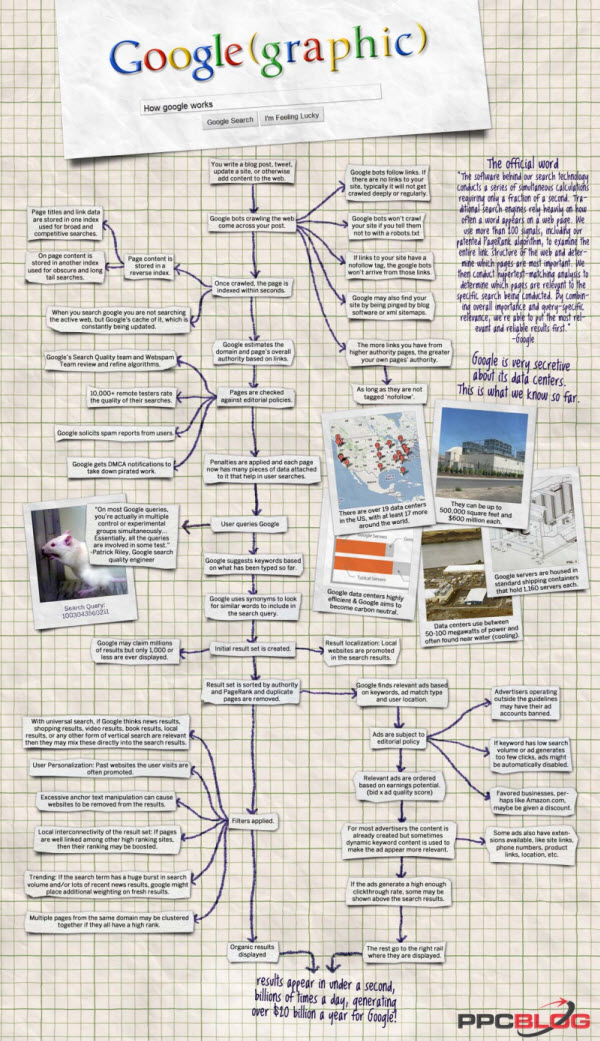
Google's algorithm changes


Interesting post on changes to Google’s search algorithms (& an overview of 9 algorithm changes that have been released to the public)

"Google is trying to become more open about their search algorithm changes. Beyond the much-discussed "fresh" update, Google discussed recent changes in SERP (Search Engine Results Page) titles and descriptions, date-specified searches, image search signals, and more.
While Matt Cutts called this "An experiment in radical transparency", the information remains fairly veiled and covers only a small portion of the algorithm changes that have been made."

Saturday, March 19, 2011

Sunday, October 31, 2010

Presentations from Internet Librarian

Speaker presentations for Internet Librarian are now available online, no required login.

Search engines, discovery tools, Bing, gadgets, IA (Information Architecture), the eBranch, Mobile, digital identity, and more.

Sunday, June 20, 2010

Visual mapping search engine

http://www.visualthesaurus.com/

A visual mapping search engine which has a free demo, although it is a paid site.

Wednesday, June 9, 2010

Visual mapping search engine

http://www.visualthesaurus.com/

A visual mapping search engine which has a free demo, although it is a paid site. An interesting way of looking at information.

Monday, November 23, 2009

What's up with wolfram alpha?

Interesting little post about wolfram alpha and plans for the future:

But Alpha may yet confound the sceptics. Last month, Wolfram released an application programming interface, or API, that allows anybody to build software or websites that use Alpha's abilities. "Alpha is a technology platform that allows one to inject computable knowledge into any application or computer system," says Wolfram.


and it's partnering with bing... more here.

Sunday, November 22, 2009

Google Key Word Significance -- new webmaster tool

Well, this is interesting... some thoughts on a new tool in the google webmaster's toolbox.... Just goes to show that mining content doesn't always tell you relevance. Sometimes controlled vocabularies (subject headings) and taxonomies (categories) are a GOOD thing... Sigh...

Here is what Google says the keyword significance list is for:
Below are the most common keywords Google found when crawling your site. These should reflect the subject matter of your site.
Google is basically looking at your website, sorting its content by the number of times each word was used, and revealing to you what keywords you use the most. It’s similar to a tag cloud, but instead of being all crazy looking like a cloud it just nicely organized.


...but then....
Using this site as an example I found that the sixth most used word was “Post”. This website isn’t about a post or posts. Doing some quick on site research revealed, I often referenced other posts on the site with terms like next post, previous post, or popular post. Eliminating the unnecessary uses of the word will improve the way Google sees my site. Keyword density for more important words will now also rise up more. Now I just need to delete all those articles I wrote about on how to paint a white fence post.


So, you should just use words in your posts that you want to reflect on the relevance of your website to a particular subject in google, am I reading that right? So, if I want this site to rank high for "semantic web" I should just type the term semantic web a million times and that would do it? Sounds like another opportunity for spam hits in google...

Tuesday, November 10, 2009

5 Years of Firefox (and the web)

Very interesting (and short) review of the last 5 years for Firefox and web in general....

“All of our servers melted instantly,” Vukićević says. “We spent an hour trying to get the downloads back up.”
(on the day Firefox launched)


....and looking to the future:
"“We always ask, ‘What is it that people on the open web can’t do right now? What’s pushing them towards things like Adobe AIR and Silverlight, or other technologies that are single-vendor silos?”

When a developer loses the ability to view a web page’s source code (something you can’t easily do in Flash) they can’t see how web applications and complex interactions function. And, he says, that stymies further experimentation.

“The web is going to be an awesome place to innovate in five years, because we’re going to chase down every awesome development in the proprietary world and make sure it happens on the open web as well. If we fail, then we’ll end up in a place that’s less recognizable than the web today, a web filled with a bunch of internet-delivered Flash executables.”

Read the Wired article here

Monday, November 9, 2009

NYT project / Mapping name subject headings (semantic web)

I am so excited about this NYT project -- just the kind of thing needed to start moving the semantic web forward ... By the way, DBPedia is an attempt to take Wikipedia data and semanticize it... I am kind of in love with linked in data at the moment.

Article at
http://tinyurl.com/yhdayvr

"Over the last several months we have manually mapped more than 5,000 person name subject headings onto Freebase and DBPedia. And today we are pleased to announce the launch of http://data.nytimes.com and the release of these 5,000 person name subject headings as Linked Open Data. "

... we plan to expand http://data.nytimes.com to include each of the nearly 30,000 subject headings we use to power Times Topics pages, a collection that includes locations, organizations and descriptors in addition to person names.

When we first announced this initiative, we asked for participation from the global semantic technology community. We have heard from a diverse community of experts, and their advice, guidance and feedback have proved invaluable. To further encourage community participation, we have created The New York Times Linked Open Data group and urge all interested folks to sign up.

Tuesday, November 3, 2009

Using RSS to find new sites (Google news)

So, Google announced that:
Google uses numerous sources to find new webpages, from links we find on the web to submitted URLs. We aim to discover new pages quickly so that users can find new content in Google search results soon after they go live. We recently launched a feature that uses RSS and Atom feeds for the discovery of new webpages.


Oh you people with crappy design, content and metadata, in theory, if you can generate a RSS, Google can find you. LOL

Read about it here...

Wednesday, October 21, 2009

Semantic web, social web, and the progression of the web (presentation)

Well, this is a pretty unwieldly subject to pack into a 1 hour presentation (and I didn't go very far into the details of the mechanics of the semantic web, at all)....

Wednesday, September 2, 2009

what is a browser?


interesting, even though I'm not sure the general person needs to know the difference between a browser and a search engine, especially, as companies like google and microsoft offer both. One is just how you get there and the other is what you use to search. I certainly am not going to uncollapse my category of search engines/browsers here ;-)

Monday, August 10, 2009

Biggest news in social media today --- Facebook + Friendfeed, and a little about Wowd)

If you haven't heard/read (and you don't follow my tweets -- georgiawebgurl@twitter), Friendfeed has been bought by Facebook. Read about it here and here.

On another note, I asked for an invite for Wowd. I am interested to see how this will differ from StumbleUpon. Both seem to be in the popularity contest site recommendation field, but Wowd seems to be actually building a search engine based upon automatic recommendations. Very interesting. I seem spammers and SEO blackhatters having a field day.

Wowd:
Roughly, it works like this.

I'm a member of the Wowd network, and I visit a new web page. My local Wowd client first checks to see if that web page is publically available -- meaning, can other people out there on the web see the same page that I’m seeing.

If I’m visiting a public page, then the site is nominated for inclusion in the Wowd index. No personally identifiable information leaves my machine!

By visiting the site I'm simply and implicitly voting for it. That's all. The indexing of the publically available site is done from another machine in the Wowd network, not mine.

Tuesday, July 21, 2009

The death of IE6

If you haven't been following all of the IE6 news of late, Youtube seems to be the most recent site to discontinue support for IE6:
http://tinyurl.com/mpmu5y

Mashable says that in order for the web to progress, IE6 must go (and briefly explains the major issues with IE6):
http://mashable.com/2009/07/16/ie6-must-die/

...and if you really hate IE6, you can always join the death to IE6 movement. ;-)
http://iedeathmarch.org/

Friday, May 1, 2009

the next google?

How many times are we going to hear, "google killer" or the "next google" I wonder? Anyhow, here is another one... the behind the scenes video is kind of cool. I've requested a guest pass/invite, so we'll see if I get to play around with it before it goes live.


"Wolfram Alpha, a new "computational knowledge engine" based on the work of Stephen Wolfram. Some have dubbed Alpha a "Google killer," but, in reality, it is very different from the standard search engines that we are all familiar with today."

Screenshots, video & more at readwriteweb:
http://www.readwriteweb.com/archives/see_wolfram_alpha_in_action_-_video_and_screenshots.php

Apparently, google is also throwing out a new search engine next week.

Sunday, September 7, 2008

The story behind Chrome (google's new thang)

Are you tired of chrome yet? Not even sure what chrome is?
Here is the story of chrome (google's new browser):


..to be honest, it looks an awful lot like firefox3.... but no support for RSS Feeds? Are you kidding? Lots of chatter about its TOS, too, but apparently some of that was old verbage and has now been modified, at least, that is the official story. Bottom line is > read the TOS. ;-)
The task manager does look cool, though.

More and some how-tos...
How to:

Monday, July 28, 2008

new search engine cuil

So, some folks formerly of google have launched their own search engine, called, cuil. Looks coool, but then half of what I searched didn't even turn up 1 hit. nada. zip. (including me!)

Preferences are kind of light -- typing suggestions and safe search. I didn't see any advanced searching features.

Overall display looks pretty cool though, and I like the focus on contextual information. Rss4Lib's screenshots show search results displayed in categories, but I didn't see that. Perhaps, it was because I didn't search for a phrase using "".

The site also went down shortly after I started playing with it.

Anyhow, you can read more about at TechCrunch's Do not mistype cuil , RSS4Lib's New Google Wannabee: Culi, and Mashable's Cuil, the Dark Mysterious Google, and yet another post from TechCrunch, Google Beats Cuil Hands Down In Size And Relevance, But That Isn’t The Whole Story