Find>

Loading...

Sunday, October 31, 2010

Presentations from Internet Librarian

Speaker presentations for Internet Librarian are now available online, no required login.

Search engines, discovery tools, Bing, gadgets, IA (Information Architecture), the eBranch, Mobile, digital identity, and more.

Thursday, October 28, 2010

Archiving geocities

Some of you may remember geocities (from yahoo), an early online & free website builder. Yahoo abandoned it some time ago, but it is now being archived. Interesting (and short) article about obsolete websites, archiving, and cultural history.

http://tinyurl.com/2wmyw48

Monday, October 25, 2010

Wifi warning -- new tool provides ease of hacking into your info

This is incredibly scary but you should be aware that any time you're on a public wifi it's probably not secure.

---------------------

It’s not hard to comprehend the far-reaching ramifications of this tool. Anytime you’re using an open Wi-Fi connection, anyone can swiftly access some of your most private, personal information and correspondence (i.e. direct messages, Facebook mail/chat)— at the click of a button. And you will have no idea.

This is how it works. If a site is not secure, it keeps track of you through a cookie (more formally referenced as a session) which contains identifying information for that website. The tool effectively grabs these cookies and lets you masquerade as the user.

Apparently many social network sites are not secured, beyond the big two, Foursquare, Gowalla are also vulnerable. Moreover, to give you a sense of Firesheep’s scope, the extension is built to identify cookies from Amazon.com, Basecamp, bit.ly, Cisco, CNET, Dropbox, Enom, Evernote, Facebook, Flickr, Github, Google, HackerNews, Harvest, Windows Live, NY Times, Pivotal Tracker, Slicehost, tumblr, Twitter, WordPress, Yahoo, Yelp. And that’s just the default setting— anyone can write their own plugins, according to the post.

More on Firesheep @techcrunch


How to protect yourself in Firefox (involves the extension Force TLS) which will encrypt your data


Sunday, October 24, 2010

Reasons I won't follow you; reasons I unfollowed you


Just a reminder: If I don't follow/friend you or I unfollow (or unfan or unfriend) it's not that I like you any less (if I know you in person). If you are a colleague, it doesn't mean that I respect you any less. However, I want to be able to manage both my online presences and my brand/digital identity. Got it? I still like you -- same as did.


For twitter, I will unfollow/unfriend you for:

Quantity:
  • Lack of posting: you never or rarely post
  • You post soo much that I can't keep up
Quality:
  • Third wheel: you only (or predominantly) post replies back to your friends -- you know what? it's nice to have a dialogue, but if that is all your twitter feed is, I'd rather not be a 3rd wheel to a conversation I know little about.
  • Only post follows: #FF or #FollowFridays -- surely you can think of something to post the other 6 days of the week?
  • Spam.
  • Minutiae: if I don't know you personally, then I might not really care about that great Thai lunch you just had. Friends who shoe shop -- you're exempt on this one. ;-)
  • Geoposting: You're the Mayor of _______ in foursquare, and you talk about it all of the time... which leads me to...Geoposting. I usually do not care where you are. It IS interesting to hear that you are at a conference or event -- I get great ideas that way, but on the corner of 5th and main at starbucks? Didn't need to know that. Maybe the Library of Congress who is archiving tweets will care, but I don't. ;-)
  • Just Retweets from others. Throw in some original thoughts on occasion.
The connection:
  • I connect with you in another space which works better than twitter: linkedin, facebook, flickr, in real life (face to face) wherever. No need to create more content for either of us to wade through.
  • You follow/friend me, but I don't know you and your account is private with no info. I really want to know who you are. I don't autofollow.
  • If you can't be bothered to fill out the profile, then I'm probably not going to follow you.
  • Answer me every once in a while. Twitter is not a one way street.

Saturday, October 23, 2010

LibraryAnywhere rolls out as an iphone app

In case you haven't heard about this (some of us have chatted in my lib about this), it really looks cool.

Library Anywhere, a mobile catalog for everyone (and they just rolled out a new iphone app too)

Following on our announcement of Shelf Browse, here’s another new product. We think this one’s a pretty big deal.

Announcing Library Anywhere! Check it out on our ALA handout (available here).

* A mobile catalog for any library, up and running in minutes.
* Mobile web and apps for iPhone, Blackberry and Android.
* Cheaper than you’d guess.
* Search, place holds, and more.
* Showcase hours, branches, and events.
* No installation process.
* Works with 90% of current OPACs.
* Comes with an “accessible version” that provides a fully Section 508-compliant version of your existing catalog.

Unlike Shelf Browse, available now, Library Anywhere is “coming soon.” So, we’re looking for beta libraries.

Iphone app
http://itunes.apple.com/us/app/libanywhere/id397718881?mt=8

Friday, October 22, 2010

RDA vs. AACR2 for serials


A little powerpoint (pptx format) comparing RDA and AACR2 for serials courtesy of Renette Davis. I wish it were embeddable, but it's not.

Thursday, October 21, 2010

metadata, metadata, and library metadata & some discussion of linkedata, too)... dcmi conference proceedings

DCMI conference papers include:
http://dcpapers.dublincore.org/ojs/pubs
  • Building blocks of metadata: What can we learn from Lego™? Emma Tonkin, Andrew Hewson
  • Visualizing Metadata for Environmental Datasets Sherry Koshman
  • FRBR: A Generalized Approach to Dublin Core Application Profiles Maja Zumer, Marcia Lei Zeng, Athena Salaba
  • Enhancing Interoperability of FRBR-Based Metadata Jenn Riley
  • Moving Library Metadata Toward Linked Data: Opportunities Provided by the eXtensible Catalog Jennifer B. Bowen
  • Celebrating 10 Years of Government of Canada Metadata Standards Margaret Devey, Marie-Claude Côté, Leigh Bain, Lynne McAvoy
  • Linking Entities in Scientific Metadata Jian Qin, Miao Chen, Xiaozhong Liu, Andrea Kathleen Wiggins
  • From records to streams: Merging library and publisher metadata, Carol Jean Godby
  • The One-To-One Principle: Challenges in Current Practice Steven J. Miller
  • Better Guidelines, Better Functionality: How Metadata Supports the Cycle of System Improvement at UNT

Tuesday, October 19, 2010

Drupal class -- last call for today

If you are interested in the Intro to Drupal (which includes CMS in general, too) but you can't make today's class it will be offered again in June.

4 different futures imagined for research libraries

Interesting thoughts...
------------------
4 Very Different Futures Are Imagined for Research Libraries

The first scenario, "Research Entrepreneurs," lays out a future in which "individual researchers are the stars of the story." Corporations and philanthropists directly support the best and brightest, who "produce insights that dazzle readers, leaders, and markets." Creativity matters more than institutional or disciplinary affiliations; the best researchers write their own contracts. Research institutions "increasingly function to provide support services" rather than driving the research agenda.

Scenario No. 2, "Reuse and Recycle," describes a gloomier 2030 world in which "disinvestment in the research enterprise has cut across society." With fewer resources to support pathbreaking new work, research projects depend on reusing existing "knowledge resources" as well as "mass-market technology infrastructure." Research is likely to be less ambitious and to be "cobbled together in ephemeral and often small-scale projects." In this scenario, research institutions don't bring much to the enterprise "beyond loose organizing capacities, matching services, low-level overhead, and symbolic capital." The "crowd/cloud" approach is widespread, producing information that is "ubiquitous but low value."

The third scenario, "Disciplines in Charge," appeared to generate the most interest at the library association's meeting. In this projection, "computational approaches to data analysis" rule the research world. Scholars in the humanities as well as the sciences "have been forced to align themselves around data stores and computation capacity that addresses large-scale research questions within their research field." (Digital humanists might take issue with the choice of "forced" there.) Discipline-level "organizational structures"—not necessarily resembling the scholarly associations of today—set the research agenda and control who gets money and which researchers get to participate.

Scenario No. 4, "Global Followers," describes a research climate much like what we know now, except that the Middle East and Asia take the lead in providing money and support for the research enterprise. Globe-spanning collaborations crop up around large-scale projects. Institutions as well as individual scholars will follow the lead of those parts of the world, which will also set the "cultural norms" that govern research. That eastward shift affects "conceptions of intellectual property, research on human subjects, individual privacy, etc.," according to the scenario. "Researchers bend to the prevailing wind rather than imposing Western norms on the cultures that increasingly lead the enterprise."

Complete article at
http://tinyurl.com/2cgqv5t

Monday, October 18, 2010

Trying to post to ee and blogger at the same time

So, I have decided I'd rather just blog in one spot. Really, I just got tired of managing multiple identities on the 'net -- too much work. I really like blogger and while I like ee (ok), it is so much easier to push blogger to well... just about anything. except....
I've hit a stumbling block with labels. I can get the RSS for the label (category) but it doesn't seem to work in netblogs at facebook. I've tried to push it into Facebook a couple of different ways, and it's just not working.
I've tried running in through Feedburner and it's just hitting a wall with netblogs.

The other thing I wanted to do was push my art posts (just art posts) into my art website which is ee (expression engine). I am using ScribeFire (a firefox addon) and the Metablog API to publish to ee.
I'm not really online all of the time -- it is often an illusion. ;-)

tech support in heaven (comic)

Sunday, October 17, 2010

Mirror blogging at ee and blogger

So, this is truly a test to see if I can mirror blog/auto post to 2 blogs at the same time (long reason for why I want to do this, which has nothing to do with spam -- truly)

and a nice detail of the inprocess (getting very close to being finished though) Lucene (who is a tree nymph)


New art page


So, I'm re-working my art page at facebook. I know that you are excited.

Saturday, October 16, 2010

Customizing/styling a blogger rss feed using Feedburner

To find your blogger feed for a label (category/tag), check out this post.

Part 2 - CUSTOMIZING & STYLING A RSS FEED WITH FEEDBURNER

Open feedburner.com
  • Sigh in with feedburner using your google/gmail account login password and ID.
  • Before we can style and customize the display of our feed, we have to link it with Feedburner.
  • You should see "Burn a feed right this instant. Type your blog or feed address here:" If you've already set up some of this, you will see this option at the bottom of your existing list.
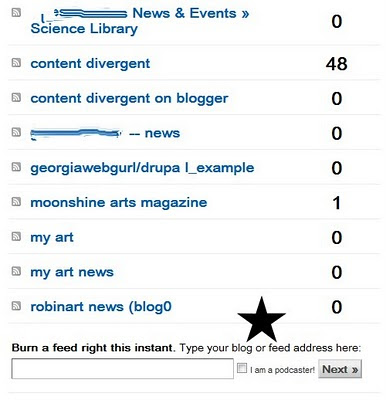
  • Type in your blogger URL -- if you want to only include a particular label (category/tag) you will need to use the URL for the category (as in Part 1a). If you want to include your whole blog, you would just put your blog url in.
  • So, in my example:
    • To style my feed just for my artwork, I would use
    • http://contentdivergent.blogspot.com/feeds/posts/default/-/my%20art
    • To style my feed for my whole blog, I would just use
    • http://contentdivergent.blogspot.com/
    • Then Click Next.

  • Feed Title: This is what will display to you in your list of feeds and MAY be displayed in your website... (in our case, a Facebook page) should you choose that option. Either way, make it short yet descriptive.
  • Feed address: You can just leave the default setting from feedburner.
  • Click Next.


So, the feed is setup through Feedburner, but we still need to customize and style it.

Click Next. (This will allow you to also setup statistics for your feed for Free!)
I'm not going to be doing podcasts, so I just check the other options.


So, I check Clickthroughs and Feedburner stats, Then Next.
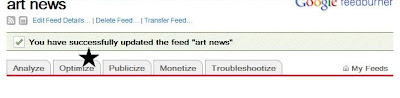


First, I'm going to optimize (though you can do this in most any order). I'm going to keep this simple and really not do too much customization.

The 2 most basic features are to make it browser friendly (just makes it more portable) and then smart (for mobile, etc.) So, we'll click first on BrowserFriendly and then SmartFeed.


BrowserFriendly: Probably the most important here is the choice of how the feed displays -- do you want just titles or content? I want both. You can also add a personalized message too. Like subscribe here, or something like that.
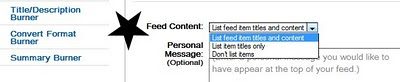
SAVE it to activate it and save the configuration.


Now to make our feed compatible with any service and then onward to publishing our widget (code)
Click on SmartFeed.


Click on Activate to make your feed compatible with any reader.


Now we're going to Publicize our feed (in other words, style and customize it for use on another website, Facebook, or well, just about any place...)
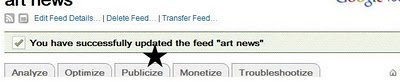

There are all sorts of choices here, so you may want to experiment. We'll start with BuzzBoost which creates code compatible with HTML.

Basically, I've told it to show 10 items from my blog in html formatting (which should include links and images).

I've removed feed title, because I will customize that in Facebook.

Since I am the single author, there is no need to really include my name after every post. If you had a multi-author blog, that might be a very important feature.

Since I am using this to push content elsewhere, I don't really care to have the link to the feed display.

Once I make all of my selections, I will click Activate to save and get my code.


More customizing using buzzboost -- styling and aggregating from multiple blogs (could use multiple categories in blogger, too> available here

Copy and paste code for use in webpages, Facebook, etc.

Blogger feed by label (tag/category) -- getting your URL

This post covers how to get a blog label / tag (category) into feedburner (or even how to determine what it actually is). If you need to know how to style your RSS Feed or repackage it for a HTML only page, you'll want to check out
If you're trying to get your blog into a Facebook page, there are a couple of different options, which I will cover later. Unfortunately some of the apps/tools in Facebook for pulling in feeds do not seem to work as well with the label feed, but I'm testing some ideas.

PART 1 -- HOW TO GET YOUR BLOGGER FEED FOR A LABEL / TAG (CATEGORY)
First click on a tag/label to get your url for that category (you do not need to be logged into blogger).
This is my link for my tag, my art
http://contentdivergent.blogspot.com/search/label/my%20art

The RSS for that category is:
http://contentdivergent.blogspot.com/feeds/posts/default/-/my%20art

In other words, you will find the URL for your tag in blogger and then replace search/label/ with
feeds/posts/default/~/

Doublecheck before you try to use it; either through editing in the address bar. You should see something that looks like this (this is firefox)


Success! -- at least in terms of getting your RSS for a category in blogger.
If that is all you needed, you are done.

Friday, October 15, 2010

Facebook changes for personal accounts -- tabs going away

Okay, so this WAS announced some time ago, but it seems that Facebook is finally moving forward with getting rid of tabs (whaaaaa....) for personal accounts. Sigh. Seems like Facebook is taking away control from users in terms of how they want to organize their content.

Read all about it here. Sigh. ;-(

Analytics the family analogy

My explanation/analogy for explaining analyzed titles, aka analytics to new staff:

You and your sister share the same DNA (bibliographic information), but you do not share the same last name because she is married and changed her name. Analytics are kind of like that -- they are individual people FIRST (so we catalog them on a mono record), but then to tie them to their families we give them a new last name (in the case of books -- call numbers and series statement). In the case of AM (analyzed monograph)/AS (analyzed serial) especially, the SAR (Series Authority Record) works as a family tree saying these belong together and we give them the same last name. I know the family analogy is not perfect, but it's the best we've come up w/ to discuss analytics.

Thursday, October 14, 2010

What is a library? (video)

Monday, October 11, 2010

Free webinar: Cataloging Defensively: When to Input a New Record in the Age of DDR

OCLC invites you to join us for a free, live webinar entitled:
Cataloging Defensively: ‘When to Input a New Record’ in the Age of DDR.

Description: OCLC’s “When to Input a New Record”http://www.oclc.org/us/en/bibformats/en/input/default.shtm#CHDBCBBA, a chapter contained in Bibliographic Formats and Standards, provides a common basis for decision-making in the creation of WorldCat records by member libraries. With the full implementation of OCLC’s new version of automated Duplicate Detection and Resolution (DDR) in early 2010, it is now more important than ever to know when to create a bibliographic record that clearly distinguishes itself from similar ones that describe different manifestations. During the webinar, you will also learn about safeguarding unique bibliographic records to prevent them from merging via DDR.

Presenter: Jay Weitz, MLS, Senior Consulting Database Specialist at OCLC. Jay serves as OCLC Liaison to the Music OCLC Users Group, OnLine Audiovisual Catalogers, Music Library Association, ALA's Map and Geography Round Table, and PCC Standards Committee. He is also a member of IFLA's Cataloguing Committee and Vice-Chair of IFLA's Permanent UNIMARC Committee.


Dates and times: The webinar is being offered two times. Please register for one session:

Thursday, October 28, 2010, 10:00 – 11:00 AM EDThttps://www3.oclc.org/app/request/bin/request.asp?specialCode=NewRec28Oct10
Monday, November 1, 2010, 2:30 - 3:30 PM EDThttps://www3.oclc.org/app/request/bin/request.asp?specialCode=NewRec1Nov10

Please note the times are U.S. Eastern Time and adjust for your own time zone. The webinar will be recorded and made available on the OCLC website in November.

After you register, we will send instructions via email, to access the webinar.

Sunday, October 10, 2010

FRBRized Music catalog search

Sounds interesting...
--------------
Indiana University is pleased to announce the public (very Beta) release of Scherzo, a music discovery system designed as a testbed of the FRBR conceptual model. The system may be accessed at http://vfrbr.info/search . A product of the IMLS-funded Variations/FRBR project, Scherzo is an early proof of concept for what a library catalog built according to FRBR principles might look like. The current released system is most certainly not a finished product; rather it represents an attempt to share in-progress development work with interested individuals. It is (and will continue to be) far from perfect, and the Variations/FRBR project team hopes these very imperfections help to promote community discussion on the utility of the FRBR model and how feasible mechanisms to automatically FRBRize MARC bibliographic and authority records are likely to be. We welcome and intend to participate in public discussion on this system and the issues it raises. In addition, specific feedback may be sent to vfrbr@dlib.indiana.edu.

Scherzo currently contains records representing approximately 80,000 sound recordings from the holdings of Indiana University's renowed William and Gayle Cook Music Library in the Jacobs School of Music. Work on Scherzo to date has focused most heavily on FRBR Work identification from MARC and basic results display in a FRBRized environment. While we have paid some attention to user interface design, it is not our project's primary concern. The search system currently resides on a test server; while we expect the service to be generally available, please excuse any temporary down time or unexpected restarts.

In the relatively short term, we have a number of planned improvements to the system, including a keyword search, improved Work identification processes, representing more specific roles that Group 2 entities have to Group 1 entities (beyond created by, realized by, and produced by defined in the FRBR reports), and bulk download of the source data powering this system in XML. In the slightly longer term we hope to make the source data available as Linked Data as well.

For more information, you may see detailed specifications for our MARC to FRBR record transformation
http://www.dlib.indiana.edu/projects/vfrbr/projectDoc/metadata/mappings/spring2010/vfrbrSpring2010mappings.shtml, or the project home page http://vfrbr.info

Friday, October 8, 2010

This is from an Adobe press/news release about the 21st Century Communications & Video Accessibility Act of 2010 which is intended to "increase access to video programming on television and the internet, require as access to the user interfaces used to access information online via smart phones, and require access to on-screen menus for DVD players and set-top boxes."

Specifically, the bill establishes that:

1. Within one year of passage of the Act that the FCC will define regulations to make Advanced Communications Services accessible to and usable by people with disabilities (Section 716)
2. Effective three years after passage of the Act, internet browsers built into mobile phones will need to support accessibility in the browser’s features and functions (Section 718)
3. Within 60 days the FCC will establish a committee to advise on video programming and emergency access, and that group will develop reports (Section 201)
* a report within 6 months which includes deadlines for the delivery of closed captioning services
* a report within 18 months recommending the schedule for the delivery of video description
4. Within 6 months, the FCC will set a schedule for requiring closed captions on video displayed online, for video that was delivered with captions on broadcast television. (Section 202)
5. The FCC will commence an evaluation within one year of the passage of the Act to investigate the technical challenges, benefits, and technical challenges around video description for online video. (Section 202)
6. The FCC will define regulations within 18-36 months which require access to the controls that accompany video programming (e.g. play, pause, closed captioning, volume controls) to enable access for people who are blind or visually impaired. (section 204)
7. The FCC will define regulations within 18-36 months which require on-screen menus and program guides to be accessible to people who are blind or low-vision. (Section 205)
more here and the official bill here.

Thursday, October 7, 2010

New features: Privacy controls, download your data, & Facebook Groups -- does everybody hate them?

Facebook news roundup:
So, some are reporting that it is Opt Out only, and others say, it is Opt In only. Either way, it's confusing and yet another, potential privacy issue. Some call it "twitter for facebook". Hmm.

Other new features rolled out are the ability to download your data (I can see where this would be useful), as well as a new privacy settings which will be esp. useful for social gamers.

You know I really just want to be able to change the type of page I have and have more control over who sees what. I don't need to add more people to my personal network.

Monday, October 4, 2010

New Georgia Encyclopedia Survey (your opinion matters)

Disclaimer: I actually wrote a few articles for NGE in the Arts/Entertainment category. You can read them here, if you would like. (It would be nice if my name were hotlinkable, ha! I should've added that into my survey response, I suppose).

----------------
Many of you in all kinds of libraries are New Georgia Encyclopedia users, and the NGE wants your input on what the Next Generation NGE may look like. The NGE is hosted by GALILEO and is in partnership with the Georgia Humanities Council and UGA Press. Your feedback and that of other staff and patrons will help guide the design and content for the next version and provide the basis for fundraising and grant application activities. You can find the link to the survey on the NGE home page at http://www.georgiaencyclopedia.org


Sunday, October 3, 2010

Learning to manage my life> Reasons I don't follow or friend you


I decided to update my reasons I unfollow/unfriend because 2010 is my year to simplify, focus, and stay true to my intentions (it's a yoga thing...)


If I unfollow (or unfan or unfriend or do not accept your request) it's not that I like you any less (if I know you in person). If you are a colleague, it doesn't mean that I respect you any less. If you are a fellow artist/graphics/web, it doesn't mean that I dislike your work.

However, I want to be able to manage my online presences, my brand/digital identity, and have a real life. Do you know how much real time is used in creating a mixed media work? A whole lot and I need to be doing more of that.

Connect with me @: twitter, my blog, or linkedIn (please add a note to your request). You can also connect with me at my facebook page.


Reasons that I will unfriend/unfollow/deny your request:


  • Already connect with you online (or in real life):If I already connect with you in one space (facebook, twitter, IRL, etc.) I will stick with whichever space is better. No need to duplicate effort and content.
  • Infrequent posts: If you go 2 months without posting, I will unfriend/unfollow you. If you have just a few tweets, I may wait to follow you back.
  • Irrelevant posts:
    • You only (or predominantly) post replies back to your friends -- you know what? it's nice to have a dialogue, but if that is all your twitter feed is, I'd rather not be a 3rd wheel to a conversation I know little about.
    • You broadcast only - never responding to my mentions, comments or questions. (News agencies/sites are exceptions).
    • You only post follows: #FF or #FollowFridays -- surely you can think of something to post the other 6 days of the week?
    • *You only post spam (duh) / spam me.
    • You only post minutiae -- if I don't know you personally, then I might not really care about that great Thai lunch you just had. Friends who shoe shop -- you're exempt on this one. ;-)
    • You're the Mayor of _______ in foursquare, and you talk about it all of the time... which leads me to...
    • Geoposting. I usually do not care where you are. It IS interesting to hear that you are at a conference or event -- I get great ideas that way, but on the corner of 5th and main at starbucks? Didn't need to know that. Maybe the Library of Congress who is archiving tweets will care, but I don't. ;-)
    • It's all about your family, who I do not know. I'm not a stalker and would prefer not to eavesdrop on your life.

  • Private/Profile information (not sure who you are or why I should follow you)

  • Language barriers - you post in a language I don't read - true there are translators out there, but it seems pointless to use those for social space

  • Wrong request: I will suggest an alternate after all, I'm not mean, just trying to manage my life better. Of course, this is my life and I reserve the right to change the rules. ;-)
  • Saturday, October 2, 2010

    Projects, training & more (what I'm up to) : Drupalcamp, webdesign, digital identity, tweeting & more

    Just a quick little update letting you know where I'll be and what I'm doing:
    • Today> DrupalCamp : Goal is to absorb as much related to publishing as I can and also get a few more ideas for my Intermediate Drupal class I'll be proposing to teach for Lyrasis for Winter semester. I dumped epublish (articles wouldn't "stick" to their issues) and I've looked at openpublish, but I don't really want to start the site from scratch (although I could, but I would then need to reload my database). I hope to re-launch moonshine arts magazine really soon, but I need to work out the publishing platform. I know how to do it using the book module and I *could* do it that way, but really want it to be a true journal platform.
    • Continuing for next 2 weeks: I'm taking a "web design" class through the webacademy. The class is really good and if you have never used Wordpress or GIMP (image editing, kind of like a free version of photoshop -- it's not but they do have similarities), it would be PERFECT for you. Alas, it's way elementary for me (and I've even taught similar classes), but I've been able to help out some of my fellow students in the chat, and I have picked up a couple of small tips, though nothing I couldn't have googled. So, why did I sign up? 1. Description didn't state audience level so I really didn't know and 2. Free.
    • Oct, 6 @ UGA Libraries; Oct 13 @COMO/GLA : Your Voice: Professional Networking & Digital Identity
      Free > Teaching 2 hour workshop on digital identity (will cover privacy and controlling identity, too) , personal branding, reputation management, developing influence, and credibility, aka digicred. Tools covered facebook, linkedin, twitter, etc. Losely based upon on my Digicred seminar.
    • Oct. 13: 1 voice, many channels w/ @Amy Watts: Teaching a session on tweeting and blogging for libraries; I'm covering blogging; Amy will cover twitter, but we'll tag team the whole preseno through. If you've never been to one of our presentations, we always get great feedback. Free @ COMO.
    • Nov. 11, Intro to Drupal for Libraries (Lyrasis)
    • Dec.4-6: TedX for Women / Coordinator (still working out logistics, but contact me at georgiawebgurl@gmail.com if interested)

    Friday, October 1, 2010

    DrupalCamp, Drupal & the ejournal saga.. or how I became a Drupal Girl.


    Super excited about DrupalCamp tomorrow because there are 2 sessions for publishing and one for openpublish!

    As some of you know, I've been editing an online arts & literary journal, called moonshine, which was housed on an opensource publishing platform called PacerCMS. The only problem with that product (which worked perfectly) is that support is really limited and no one (including me, who was volunteering) has a lot of time to devote to development. So, I started exploring Drupal. I use Drupal (and teach on Drupal for Lyrasis, next intro class is Nov. 11). I love Drupal.

    I should probably issue a disclaimer though: Drupal was not my first CMS love though -- that would be ee (Expression Engine). ee and I broke up (it was an early relationship as I was one of the early implementers of the post-Pmachine, ee). When I started using ee (migrated from MT aka Movable Type which was a migration from GreyMatter -- yes, you blogging photographers, from the 2000/2001 era, feel free to take a moment...), Drupal was hmm...

    Drupal 4(?). something (if I remember correctly)... and it was awful. Actually, it wasn't, but theming meant working with bunches of html and template files; there was no CSS theming as there is now. Installation was a nightmare and documentation was awful (imho). It was (probably) a programmer's dream and a designer's nightmare.

    So, I jumped into the world of ee and loved it. I still love alot of things about ee and hate some things about ee. I watched from afar as Drupal went through 5, and then at 6, I noticed some significant changes with Drupal. Drupal sites started looking like real websites -- real websites with beautiful designs. ee was becoming more restrictive in terms of noncommercial licensing, I never had an ee upgrade that went properly (tech support ALWAYS had to help me) and was moving already towards its pay-to-play model that it supports now.

    Soooo... I downloaded a copy of Drupal 6 and starting building my website. Wow, it was great and wonderful and so powerful.

    ...which is where I am now. I kind of want to Drupalize everything. ;-) I want the policy and procedures manual that I am the caretaker of (all 250 PDFs and growing) to be Drupal, but Drupal doesn't really have a doc management system at the level I need (I know, I could probably create something, but I'm looking for out of the box solutions... modules that will hopefully be supported with future versions of Drupal...) and I've found a DMS (KnowledgeTree) which can be incorporated into Drupal.

    ...and regarding that ejournal? I set up Drupal, styled it and started working with epublish, but I was really having problems with articles "sticking" in their issues. So, I'm looking to openpublish which I've installed but not set up yet, for which there is a session at DrupalCamp in ATL. So excited... and hope to have a new announcement about moonshine soon...and you'll finally get to see my finished painting, Leuce.

    Also for those of you in my area>
    ath drupal group.
    http://groups.google.com/group/athdrupal